 NBCNGMI™
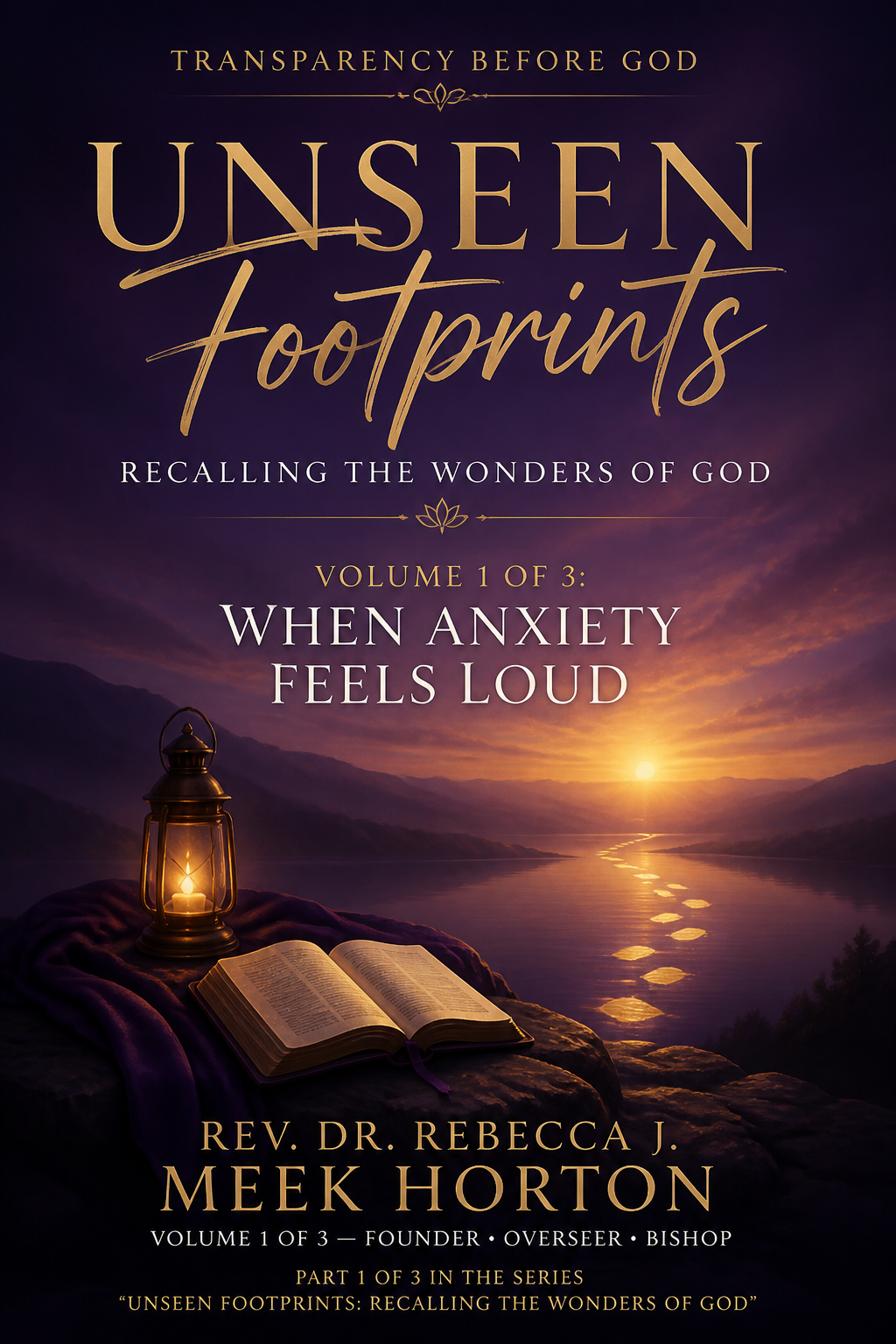
Unseen Footprints: Recalling the Wonders of GOD · Volume 1
When Anxiety Feels Loud
Part 1 of 3 in the series "Unseen Footprints: Recalling the Wonders of GOD". Series theme: Transparency Before GOD Series arc: This three-book series moves from honest distress to holy remembrance to steady trust. The first book begins where the source manuscript begins: Psalm 77 and the freedom to bring anxiety, unanswered questions, and the whole self before God. The second book widens the lens,
Chapter 1 preview
NBCNGMI MASTER KNOWLEDGE LIBRARY Featuring the works of The Sage, Apostle Prophet. Rev. Dr. Rebecca J. Meek Horton, Apostolic Prophetic Architect, NewBeing Creation Network Global Ministries, Inc. Integrated Framework Modalities™
Dedication
I dedicate this book to every heart that has cried out to GOD in the night and wondered if anxiety made them weak. May these pages remind you that you can come honestly, remember faithfully, and take the next step with Him.
Purpose
I wrote this book for the person whose anxiety feels loud, whose prayers feel unfinished, and whose heart needs permission to come before God honestly. Rooted in Psalm 77, my hope is that these pages help you cry out without shame, ask your real questions, remember the wonders of GOD, and receive the peace He promises in Philippians 4:6-7. May you learn to cast your care upon Him, as 1 Peter 5:7 teaches, and take the next faithful step with God.
Preface
This book began with Psalm 77.
Not as a neat lesson, but as a mercy. I was listening for the honest sound of prayer when the heart is not settled yet. Psalm 77 does not begin with polished confidence. It begins with crying. It begins with trouble in the night. It begins with a soul that cannot be quickly comforted.
That matters to me.
It matters because many people love GOD and still feel anxious. Many still pray and still wrestle. Many still believe and still carry questions they are afraid to say out loud. Somewhere along the way, some of us learned to think we had to calm down before coming to God. But Psalm 77 teaches another way. We come to Him with the whole self. The trembling self. The questioning self. The tired self. The honest self.
Psalm 77:1-3 (KJV) I cried unto God with my voice, even unto God with my voice; and he gave ear unto me. In the day of my trouble I sought the Lord: my sore ran in the night, and ceased not: my soul refused to be comforted. I remembered God, and was troubled: I complained, and my spirit was overwhelmed. Selah.
When Anxiety Feels Loud is the first book in Unseen Footprints: Recalling the Wonders of GOD. This first part begins with transparency before GOD because honest prayer is not a failure of faith. It is often the first faithful step back into trust.
In these pages, we will move with the psalm: cry out, ask honestly, remember specifically, and trust God one step at a time. We will not pretend anxiety is small. We will not shame the weary. We will not make quick answers where Scripture gives us a holy process.
We will learn to cast our care on the One who cares for us.
1 Peter 5:7 (KJV) Casting all your care upon him; for he careth for you.
As you read, keep your Bible near. Move slowly. Tell the truth. Let GOD meet you in the place you have been trying to hide.
Nothing is random. Nothing is wasted.
Your next faithful step is simple: come before GOD honestly today, even if your voice shakes.
Introduction
Anxiety can feel loud enough to drown out prayer.
It can fill the room before anyone else speaks. It can make the body tense, the mind race, and the soul wonder whether something is wrong with its faith. Some people suffer quietly because they think God only welcomes calm prayers, clean emotions, and carefully chosen words.
Psalm 77 teaches us something better.
Psalm 77 does not begin with a settled heart. It begins with a cry. It gives language to the person who is troubled, sleepless, overwhelmed, and full of questions. The psalmist does not hide distress from God. He brings it before Him.
Psalm 77:1-3 (KJV) I cried unto God with my voice, even unto God with my voice; and he gave ear unto me. In the day of my trouble I sought the Lord: my sore ran in the night, and ceased not: my soul refused to be comforted. I remembered God, and was troubled: I complained, and my spirit was overwhelmed. Selah.
This book begins there.
When Anxiety Feels Loud is a devotional guide for people who feel anxious, ashamed, spiritually weak, emotionally tired, or afraid to tell God the whole truth. Its message is simple: distress is not the absence of faith. Honest prayer is not failure. God does not require you to calm down before you come to Him.
Transparency before God is the first act of faithful prayer.
This is Part 1 of the Unseen Footprints: Recalling the Wonders of GOD series. The full series moves from honest distress to holy remembrance to steady trust. This first book stays close to the beginning place: the courage to come before God without pretending. Before we can remember rightly, we must stop hiding. Before trust becomes steady, prayer must become honest.
Psalm 77 gives us a faithful movement for loud anxiety:
Cry out.
Ask honestly.
Remember specifically.
Trust God one step at a time.
This is not a formula to control God. It is a path of return. It teaches the soul how to move when fear is speaking, when answers are delayed, and when God’s presence does not feel obvious.
Philippians 4 reminds us that anxious care can be brought to God in prayer. Not denied. Not decorated. Brought.
Philippians 4:6-7 (KJV) Be careful for nothing; but in every thing by prayer and supplication with thanksgiving let your requests be made known unto God. And the peace of God, which passeth all understanding, shall keep your hearts and minds through Christ Jesus.
First Peter gives the same tender invitation.
1 Peter 5:7 (KJV) Casting all your care upon him; for he careth for you.
As you read, do not rush. Let each chapter meet you where you are. Keep a Bible nearby. Keep a journal if you can. When a question rises, write it down. When a memory of God’s faithfulness returns, write that down too. This book is not asking you to perform peace. It is inviting you to practice coming near.
There is also a necessary kindness here. Anxiety, trauma, grief, medical conditions, and mental health struggles are not proof that you are spiritually inferior. Prayer matters. Scripture matters. Wise pastoral care, safe community, and appropriate professional support can also be part of faithful stewardship.
God is not afraid of your trembling.
He is not offended by your honest cry.
He is near enough to receive the whole self: body, mind, memory, fear, faith, and need.
Begin with one honest sentence before God today. Do not polish it. Do not explain it away. Simply pray, Lord, this is what feels loud in me right now. Then sit with Psalm 77 and let God teach you how to come.
Chapter 1 — When the Room Gets Loud
The room is quiet, but your body does not know it.
The lights are off. The house has settled. No one is asking you a question. No phone is ringing. No emergency is in front of you. Still, something inside feels crowded.
Your mind replays the conversation.
Your chest tightens.
Your thoughts move faster than your prayers.
You tell yourself to stop. You remind yourself of what you believe. You may even quote a verse, hoping it will work like a switch. But the noise keeps rising.
And then another fear enters the room: *If I really trusted God, would I feel this way?*
That second fear can be heavier than the first. Anxiety is painful enough. Shame makes it lonelier.
This chapter begins with a simple truth: distress is not proof that faith has failed. Psalm 77 shows us that God receives the anxious cry before anything feels resolved.
The psalm does not begin with calm. It begins with a voice.
“I cry aloud to God, aloud to God, and he will hear me” (Psalm 77:1).
Not after the trembling stops.
Not after the questions are answered.
Not after the person praying has become composed.
The cry comes first.
## The Noise Inside Is Real
Anxiety can make a normal room feel full.
A small concern becomes a loop. A memory becomes an accusation. A possible future becomes a threat. The body responds as if danger has already arrived. Sleep becomes difficult. Silence becomes uncomfortable. Prayer can feel strained.
For many believers, this is where confusion begins. We know God is faithful. We know Scripture tells us not to fear. We know Jesus cares for His people. So when anxiety remains loud, we may assume something is wrong with us spiritually.
We may think mature Christians should be steadier than this.
We may think strong faith should feel peaceful all the time.
We may think God is disappointed that we are still struggling.
Psalm 77 gives us a more honest place to begin.
The psalmist, Asaph, does not hide his distress. He does not soften it. He says, “In the day of my trouble I seek the Lord; in the night my hand is stretched out without wearying; my soul refuses to be comforted” (Psalm 77:2).
That is not a polished sentence from a person pretending to be fine. It is the language of someone awake in the night, reaching toward God while still feeling unrest.
“My soul refuses to be comforted.”
Many people know that feeling. Comfort is offered, but it does not land. Advice is given, but it does not quiet the mind. You tell yourself true things, but your heart still feels unsettled.
Psalm 77 does not shame that experience. It gives it words.
That matters because unnamed pain often grows in the dark. When anxiety is treated as something we must hide from God, we become divided. We bring God the acceptable parts of ourselves and manage the rest alone.
But prayer was never meant to be performance.
Prayer is where the whole self comes before the living God.
## Faith Can Cry Aloud
Psalm 77 opens with repetition: “I cry aloud to God, aloud to God” (Psalm 77:1).
The repeated phrase carries weight. This is not a passing thought. This is not a quiet religious habit tucked neatly into a calm morning. This is urgent prayer.
A cry is not always graceful. It may be broken. It may be brief. It may sound like, “Lord, help me.” It may sound like, “I do not know what to do.” It may sound like tears with no sentence attached.
Still, it can be faith.
Faith is not measured by how calm your voice sounds. Faith is seen in where you turn with your distress.
A child crying in the night is not rejecting the parent. The cry is a form of reaching. The child may be afraid, confused, or overwhelmed, but the cry says, “Come near. I need you.”
In Psalm 77, Asaph cries to God. His distress does not drive him away from God; it drives him toward God. That movement matters.
There is a difference between bringing our anguish to God and using our anguish to avoid Him. Psalm 77 teaches the first way. It gives permission to come honestly, without waiting for emotional control to arrive first.
This is important because some people were taught, directly or indirectly, that faith should always sound certain. They learned to speak in clean sentences even when their souls were unraveling. They learned to say “God is good” while quietly believing they were not allowed to say, “I am afraid.”
But Scripture is not afraid of honest prayer.
The Bible includes lament, tears, protest, waiting, silence, and groaning. The Lord does not require His people to deny their trouble in order to honor Him. He invites them to bring their trouble into His presence.
Psalm 34:18 says, “The LORD is near to the brokenhearted and saves the crushed in spirit.”
Near.
Not far from them because they are crushed.
Not waiting until they are stronger.
Near.
## God Hears Before You Feel Better
The promise in Psalm 77:1 is not that Asaph immediately feels better. The promise is that God hears.
“I cry aloud to God, aloud to God, and he will hear me.”
That is a different kind of comfort than many of us first want.
We often want immediate relief. We want the anxious thoughts to stop. We want our bodies to settle. We want assurance we can feel. Those are good desires. God is kind, and peace is a real gift.
But Psalm 77 begins deeper than relief. It begins with relationship.
God hears His people.
A person can be heard before the situation changes. A person can be held before the symptoms lift. A person can be received by God before the inner storm quiets.
Think of someone sitting beside a hospital bed. They cannot fix the diagnosis. They cannot erase the pain. But they stay. They listen. They keep watch. Their presence does not answer every question, but it changes the loneliness of the room.
God’s hearing is not passive like human listening can be. He is not merely aware of sound. He is attentive, faithful, covenant-keeping, and near. When His people cry, their cries do not disappear into the ceiling.
This does not mean we will always feel heard right away.
Psalm 77 is honest about that too. In verse 3 Asaph says, “When I remember God, I moan; when I meditate, my spirit faints.”
That sentence may surprise us. Remembering God does not immediately soothe him. Meditation does not instantly strengthen him. Even spiritual thoughts feel heavy.
There are seasons when prayer itself feels difficult. You try to think about God, and your spirit feels faint. You try to remember what is true, and the ache rises with it.
Psalm 77 does not cut that line out.
God preserved it for us.
That means He is not embarrassed by the prayers we are embarrassed to pray.
## The First Promise Is Welcome
This book begins here because many anxious people assume they must become less anxious before they come to God.
Psalm 77 says otherwise.
The first promise is not that you will understand everything. It is not that you will never feel afraid again. It is not that every prayer will end with immediate calm.
The first promise is welcome.
God receives the cry.
That welcome does not make anxiety good. Anxiety can be exhausting. It can distort perspective. It can make obedience feel costly. It can affect the body, relationships, work, and rest. Some anxiety also needs wise care from doctors, counselors, pastors, and trusted companions. Seeking help is not failure. It can be one way of stewarding your life before God.
But anxiety does not make you untouchable to God.
You do not have to hide until you are steady.
You do not have to edit your prayers until they sound impressive.
You do not have to pretend the room is quiet when it is not.
The way forward in Psalm 77 begins with transparency before God. Not drama for its own sake. Not despair as an identity. Not rehearsing fear until it rules the heart. But honest coming.
“I cry aloud to God.”
That is the doorway.
The tension is that this kind of prayer asks us to stop managing our image before God. It asks us to tell the truth. That can feel vulnerable, especially if we are used to measuring spiritual health by how composed we appear.
But God is not helped by our pretending.
And we are not healed by hiding.
The anxious cry is not the end of the journey. Psalm 77 will move through questions, remembrance, and trust. But it starts here, because this is where many of us are.
In the loud room.
With tired bodies.
With scattered thoughts.
With faith that may feel small but is still reaching.
And God hears.
## Key Takeaways
- Distress is not proof that faith has failed.
- Psalm 77 begins with an honest cry, not a calm heart.
- God receives you before everything feels resolved.
## Practice
Tonight, or the next time anxiety feels loud, pray one plain sentence from where you are.
Do not polish it.
Do not explain everything.
Simply say:
“God, I cry aloud to You, and I need You to hear me.”
Then sit quietly for one minute. Let the sentence stand before God. If more words come, offer them. If no words come, stay there. The cry itself is prayer.
This is the opening chapter. The complete publication is available in the full edition.
Back to the library