 NBCNGMI™
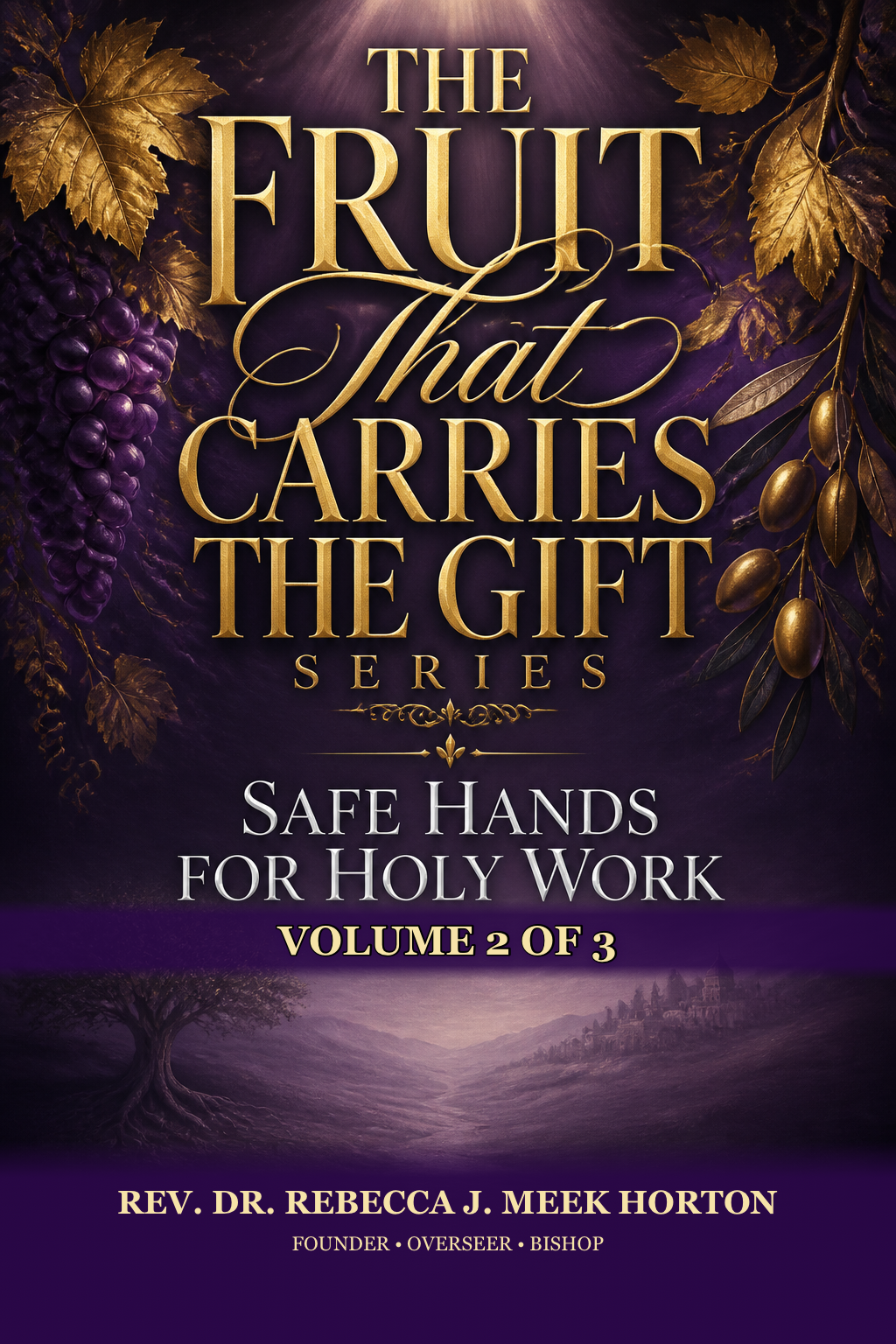
The Fruit That Carries the Gift · Volume 2
Safe Hands for Holy Work
Part 2 of 3 in the series "The Fruit That Carries the Gift". Series theme: Needed for Ministry Series arc: This three-book series moves from root to practice to stewardship. Book One establishes the inner life of abiding and the first governing expressions of Fruit; Book Two brings the Fruit into pressure, conflict, boundaries, and daily ministry reliability; Book Three shows how Spirit-formed character must govern gifts, teams, systems, and lasting service. Together, the books teach that ministry is safest and most fruitful when character carries charisma. How this book advances the series: After the root is established, this book shows whether Fruit can govern the hands, mouth, timing, motives, and boundaries of actual service. This book focuses on Fruit under pressure: longsuffering, kindness, goodness, faithfulness, meekness, and self-control. It brings formation into real ministry situations involving delay, correction, conflict, ethical decisions, follow-through, boundaries, repair, and safeguarding. It should draw from Months Five through Ten and the formation worksheets, while expanding beyond the source with ministry case studies, decision-readiness practices, conflict repair models, and practical guidance for serving without enabling harm or creating dependency.
Chapter 1 preview
NBCNGMI MASTER KNOWLEDGE LIBRARY Featuring the works of The Sage, Apostle Prophet. Rev. Dr. Rebecca J. Meek Horton, Apostolic Prophetic Architect, NewBeing Creation Network Global Ministries, Inc. Integrated Framework Modalities™
Dedication
To every servant who has learned that holy work requires clean hands, guarded words, patient timing, and a yielded heart. I dedicate this book to those who still desire to serve well, even when the work is heavy, the correction is humbling, and love must become both tender and wise.
Purpose
I wrote this book for servants who want their hands to be safe for holy work, especially when ministry becomes slow, tense, costly, or misunderstood. My hope is that longsuffering, kindness, goodness, faithfulness, meekness, and self-control will become more than words from Galatians 5:22-23; I pray they become the way you speak, decide, repair, set boundaries, and keep showing up. May this book help you serve with love, without enabling harm, carrying the gift with character that can be trusted.
Preface
I wrote this book for the servant who truly wants to help, but has learned that desire alone is not enough.
Holy work requires safe hands.
I have seen sincere people love God, carry gifts, speak with passion, and still wound others because their formation had not yet reached their pressure points. I have also seen quiet, steady servants carry the heart of Christ into hard rooms because the Fruit of the Spirit governed their mouth, their timing, their correction, their boundaries, and their follow-through.
This second book in The Fruit That Carries the Gift begins where the root has already been planted. Now we ask a harder question: can the Fruit remain when ministry becomes uncomfortable?
Can longsuffering stay when people delay, resist, or misunderstand?
Can kindness remain honest without becoming enabling?
Can goodness make ethical choices when compromise would be easier?
Can faithfulness keep showing up after the excitement fades?
Can meekness receive correction without collapse or defensiveness?
Can self-control hold the line when emotions rise?
Galatians 5:22-23 (KJV) But the fruit of the Spirit is love, joy, peace, longsuffering, gentleness, goodness, faith, Meekness, temperance: against such there is no law.
This book was born from the burden to see ministry become safer, steadier, and more faithful. Not safer because nothing hard is ever said. Not steadier because there is no conflict. Not faithful because everyone agrees. But safe because character governs power. Steady because wisdom governs movement. Faithful because love tells the truth and stays submitted to God.
Safe Hands for Holy Work is not written to shame those who have made mistakes in serving. We all need RE-Calibration™. We all need the Lord to search our motives, train our responses, and mature our stewardship. This book is an invitation to slow down, tell the truth, repair what can be repaired, and serve in a way that does not create dependency or ignore harm.
Nothing is random. Nothing is wasted.
May these pages help you carry holy work with clean hands, a guarded heart, a governed mouth, and a faithful next step.
Introduction
Ministry does not only ask what you carry. It asks how you carry it.
A gift can open a door. Character determines what happens after the door opens. A person may teach clearly, pray powerfully, organize well, counsel tenderly, or lead with visible strength. But if pressure exposes impatience, harshness, carelessness, inconsistency, pride, or impulse, the work becomes unsafe. Not always loudly. Sometimes quietly. A delayed response. A sharp word. A promise forgotten. A boundary crossed. A correction received poorly. A person helped in a way that creates dependence instead of maturity.
This is why the Fruit of the Spirit is not decoration for ministry. It is protection.
Galatians 5:22-23 (KJV) But the fruit of the Spirit is love, joy, peace, longsuffering, gentleness, goodness, faith, Meekness, temperance: against such there is no law.
Safe Hands for Holy Work is the second book in The Fruit That Carries the Gift series. Book One established the root: the inner life of abiding, love, joy, and peace. This book brings that root into the weight of actual service. Here we ask a more demanding question: Can the Fruit govern our hands, our mouth, our timing, our motives, and our boundaries when ministry becomes inconvenient?
This book focuses on Fruit under pressure: longsuffering, kindness, goodness, faithfulness, meekness, and self-control. These are not soft virtues. They are ministry safeguards. Longsuffering keeps us steady when people do not change quickly. Kindness keeps truth from becoming cruelty. Goodness protects ethical clarity when shortcuts look useful. Faithfulness turns intention into follow-through. Meekness keeps authority submitted to God. Self-control helps us serve without being ruled by urgency, emotion, attention, or fatigue.
Holy work needs safe hands.
Safe hands do not mean perfect hands. They mean yielded hands. Examined hands. Hands that can apologize. Hands that can pause. Hands that can tell the truth without wounding. Hands that can help without taking over. Hands that can set a boundary without withdrawing love.
This matters because ministry often places us near pain. People come with grief, confusion, need, immaturity, trauma, conflict, and hope. If we are not formed, we may mistake access for assignment, compassion for control, urgency for obedience, and exhaustion for faithfulness. We may try to become someone’s source instead of pointing them back to God. We may rescue what we were only called to steward.
This book will not teach you to serve less. It will teach you to serve more faithfully.
You will find Scripture, ministry case studies, reflection, decision-readiness practices, conflict repair models, and practical guidance for boundaries and safeguarding. Read it slowly. Do not read only to identify what others lack. Let the Word search your own patterns first. The safest servant is not the one who sees everyone else clearly while remaining unexamined. The safest servant is the one willing to be formed before being used.
Some chapters may comfort you. Others may correct you. Receive both as grace. Formation is not punishment. It is preparation. God does not waste pressure when we let Him use it.
As you read, keep one real place of service in mind. It may be your family, church, workplace, classroom, care role, leadership assignment, or hidden obedience. Ask honest questions there. Where am I patient? Where do I push? Where am I kind? Where do I avoid hard truth? Where am I faithful? Where have I overpromised? Where do I need to repair harm? Where do I need to stop helping in a way that keeps someone dependent?
The goal is not guilt. The goal is governed service.
1 Peter 4:10 (KJV) As every man hath received the gift, even so minister the same one to another, as good stewards of the manifold grace of God.
You have received something to steward. The gift is not the whole matter. The vessel matters too.
Begin with this simple next step: before reading the first chapter, name one current ministry pressure where you need the Fruit of the Spirit to govern your response. Write it down. Pray over it. Then read with that place open before God.
Chapter 1 — When the Work Gets Heavy
The folding chairs were still warm from the people who had just left.
A few cups sat half-full on the back table. Someone had forgotten a Bible in the second row. The prayer team was tired, the musicians were packing up, and one volunteer stood near the doorway with tears in her eyes because a conversation after service had gone wrong.
Nobody saw that part on the livestream.
They saw the singing. They heard the teaching. They watched the altar call. They may have noticed the gift.
But ministry is not only what happens when the room is full and the moment is strong. Ministry is also what happens afterward, when people are tired, expectations are high, feelings are tender, and the work still needs to be handled with care.
Every servant eventually meets the weight.
Delay comes.
Disappointment comes.
Correction comes.
Conflict comes.
Unseen labor comes.
The central idea of this chapter is simple: gifts may open doors, but only Spirit-formed Fruit can keep ministry safe under weight.
A gift can make room. A gift can draw attention. A gift can serve powerfully in a moment. But when pressure rises, the question is not only, “Can I do the work?” The deeper question is, “Can I carry the work without bruising people, distorting truth, or losing my soul?”
Galatians teaches us that the evidence of the Spirit’s work is not only power. It is Fruit.
Galatians 5:22-23 (KJV) But the fruit of the Spirit is love, joy, peace, longsuffering, gentleness, goodness, faith, Meekness, temperance: against such there is no law.
This book begins where service gets tested. Not in theory. Not in desire. Not in the first yes.
Under weight.
The Weight Always Comes
Most people begin serving with some measure of hope.
They want to help. They want to bless. They want to answer God. They want their life to matter in the lives of others.
That desire is good. It should be honored.
But desire alone does not prepare us for the heaviness of holy work.
A children’s ministry worker may start with joy, then discover that consistency is harder than enthusiasm. A prayer leader may love intercession, then become weary when people keep returning with the same wounds and choices. A teacher may enjoy study, then face correction when something was spoken too quickly or without enough care. A pastor, mentor, musician, usher, small-group leader, caregiver, or volunteer may all meet the same hidden pressure: the work is holy, but the people are human.
And so are we.
There is a kind of heaviness that comes when results are slow. You pour into someone, and they seem to move forward, then backward. You pray, plan, teach, call, check in, encourage, and still the growth appears small. If longsuffering is not being formed in you, you may begin forcing outcomes. You may push harder than grace allows. Or you may withdraw and call it wisdom when it is really fatigue.
There is a kind of heaviness that comes when people disappoint you. Someone you trusted mishandles responsibility. Someone you helped misunderstands your heart. Someone you served speaks against you. If kindness and meekness are not being formed in you, pain can turn your tone sharp. You may still say true things, but with a spirit that wounds.
There is a kind of heaviness that comes when you are corrected. A leader gives feedback. A participant says your words landed harshly. A decision you made needs to be revisited. If goodness and self-control are not being formed in you, defensiveness can rise faster than humility. You may protect your image instead of receiving RE-Calibration™.
There is a kind of heaviness that comes when nobody notices. You set up the room. You send the reminders. You clean what others leave. You show up early and stay late. You carry names in prayer that nobody knows you are carrying. If faithfulness is not being formed in you, hidden service can begin to feel like neglect.
This is not failure. This is the real place where ministry matures.
Heavy work does not create the Fruit of the Spirit, but it often reveals where Fruit still needs to grow.
The pressure is not random. The weight is not wasted. It can become a place of formation if we let the Holy Spirit search us before we serve from reaction.
Gifts Open Doors, Fruit Carries Weight
A spiritual gift can be visible long before character is mature.
A person may teach clearly but still speak carelessly in conflict. A person may pray with passion but fail to follow through on ordinary commitments. A person may lead with confidence but avoid apology. A person may discern accurately but lack gentleness in delivery. A person may be generous in public but impatient in private.
This is why the Fruit matters.
The Fruit of the Holy Spirit is not decoration for the believer’s life. It is evidence of yieldedness. It is the character of Christ being formed in ordinary decisions, strained relationships, delayed answers, and difficult moments.
In this second part of the series, we are paying attention to six expressions of Fruit under pressure: longsuffering, kindness, goodness, faithfulness, meekness, and self-control. These are not private virtues only. They are ministry safeguards.
Longsuffering helps us stay present without forcing outcomes.
Kindness helps us serve people without losing truth.
Goodness helps us do what is right when it costs.
Faithfulness helps us become dependable in small things.
Meekness helps us carry strength without bruising others.
Self-control helps us guard the mouth, motives, and moment.
Together, these Fruit expressions make our service safer.
Consider a gifted counselor in a church setting. People trust her because she listens well and seems to understand pain. But over time, she begins answering late-night messages immediately, making herself constantly available, and becoming the emotional center of other people’s decisions. At first, it looks compassionate. Then exhaustion comes. Resentment grows. Boundaries blur. People become dependent on her presence instead of learning to walk with God, Scripture, wise counsel, and responsible next steps.
The gift opened the door.
But Fruit must govern the way she stays in the room.
Longsuffering does not mean endless access. Kindness does not mean rescuing. Goodness does not mean avoiding hard truth. Faithfulness does not mean saying yes to everything. Meekness does not mean having no authority. Self-control does not mean silence when action is needed.
Fruit is not weakness. Fruit is governed strength.
When Fruit carries the gift, people are served without being possessed. Truth is spoken without being weaponized. Help is offered without creating dependency. Correction is given without humiliation. Boundaries are held without cruelty.
This is safe service.
Not perfect service. Safe service.
Safe does not mean everyone always feels comfortable. Safe means the servant is being governed by the Spirit, anchored in truth, and willing to act with humility, clarity, and responsibility.
Pressure Reveals What Is Governing Us
Pressure has a way of exposing our hidden governors.
By governor, we mean the inner force that is actually directing our response. We may say we are being led by love, but pressure may reveal fear. We may say we are standing for truth, but pressure may reveal pride. We may say we are being faithful, but pressure may reveal people-pleasing. We may say we are protecting peace, but pressure may reveal avoidance.
This is why we must learn to pause and see what is really happening.
A leader receives a message on Sunday afternoon: “I was hurt by what you said today.”
One response is immediate defense: “That is not what I meant. You misunderstood me.”
Another response is collapse: “I always mess things up. Maybe I should stop serving.”
Another response is avoidance: no reply, no repair, no conversation.
But a Fruit-formed response slows down.
It may sound like this: “Thank you for telling me. I want to understand. Can we talk at a time when we can both speak carefully?”
That response does not admit guilt falsely. It does not surrender truth. It does not allow accusation to rule. But it does make room for humility, listening, and repair.
This is where SAPP™ Discernment becomes a helpful practice. We See the situation truthfully. We Ask the deeper questions. We Ponder the motives and costs. We Practice the next faithful step.
What is really happening?
What did I intend?
What was actually heard?
What does love require now?
What does truth require now?
What response would protect the person, the work, and my own integrity?
The unformed self reacts to pressure.
The Spirit-formed servant learns to respond.
That difference matters because ministry involves people at tender points: grief, sin, confusion, hope, trauma, repentance, calling, family strain, spiritual hunger. If we serve from impulse, we may increase the burden instead of helping carry it.
Paul reminds us that the treasure is carried in earthen vessels. That phrase should keep every servant humble.
2 Corinthians 4:7-9 (KJV) But we have this treasure in earthen vessels, that the excellency of the power may be of God, and not of us. We are troubled on every side, yet not distressed; we are perplexed, but not in despair; Persecuted, but not forsaken; cast down, but not destroyed;
We carry treasure, but we are still earthen vessels.
That means we need formation. We need correction. We need limits. We need prayer. We need Scripture. We need counsel. We need RE-Calibration™ when our reactions begin to outrun wisdom.
The presence of a gift does not remove the need for maturity.
The presence of pressure does not excuse immaturity.
The Holy Spirit is able to form us in the very places where we are tempted to react.
Heavy Work Needs Safe Hands
Holy things should not be carried carelessly.
People’s stories are holy ground. Their pain is not material for our platform. Their trust is not a resource to spend for our importance. Their vulnerability is not permission for control. Their need is not an invitation to become their savior.
We are servants.
That word must stay clean in us.
A servant does not own the people. A servant does not use the work to feed ego. A servant does not hide harm behind spiritual language. A servant does not confuse being needed with being fruitful.
Safe hands remember that the work belongs to God.
That does not make us passive. It makes us careful.
Imagine someone confesses a struggle in a small group. The room becomes quiet. The leader feels the weight of the moment. A careless leader may rush to fix, preach, expose details, or make promises the group cannot keep. A fearful leader may change the subject and leave the person alone in their courage. A safe leader breathes, honors the person, protects the room, and takes the next faithful step.
They might say, “Thank you for trusting us with that. We will not handle it casually. Let us pray, and then I will connect with you after group so we can consider wise support.”
That is not dramatic. It is responsible.
Safe hands do not have to perform importance.
Safe hands know when to speak, when to pause, when to refer, when to report, when to apologize, when to ask for help, and when to say, “This is beyond what I can carry alone.”
This matters in every area of ministry.
When we handle money, goodness must govern us.
When we handle confidential information, self-control must govern us.
When we handle conflict, meekness must govern us.
When we handle delay, longsuffering must govern us.
When we handle wounded people, kindness must govern us.
When we handle commitments, faithfulness must govern us.
The Fruit does not make ministry soft. It makes ministry trustworthy.
Jesus described His own way with words that should search every servant who carries responsibility.
Matthew 11:29-30 (KJV) Take my yoke upon you, and learn of me; for I am meek and lowly in heart:and ye shall find rest unto your souls. For my yoke is easy, and my burden is light.
The Lord Jesus is not careless with power. He is meek and lowly in heart.
If He carries authority that way, we cannot justify harshness as strength. We cannot call impatience discernment. We cannot call control leadership. We cannot call exhaustion faithfulness when wisdom is asking us to receive limits.
To serve in safe hands is to let Christ’s way govern our way.
The Cost of Being Formed Under Weight
This kind of service will cost us.
It will cost us the right to react quickly just because we feel strongly.
It will cost us the comfort of being seen as right all the time.
It will cost us the false peace of avoiding hard conversations.
It will cost us the pride of being needed by everyone.
It will cost us the habit of saying yes when God is requiring a wise no.
It will cost us image, speed, convenience, and sometimes applause.
Fruit grows slowly. It grows through yielding. It grows when we let the Spirit address not only what we do, but how we do it.
This is not easy work.
There will be moments when patience feels like being overlooked. Kindness feels undeserved. Goodness feels expensive. Faithfulness feels boring. Meekness feels misunderstood. Self-control feels like swallowing fire.
But the alternative is costly too.
Without longsuffering, we pressure people into outcomes they are not ready to steward.
Without kindness, we make truth harder to hear than it needs to be.
Without goodness, we protect systems, reputations, or loyalties at the expense of righteousness.
Without faithfulness, people learn not to trust our words.
Without meekness, our strength becomes a source of bruising.
Without self-control, our mouths, emotions, and impulses can damage what we were called to serve.
The cost of formation is real.
The cost of unformed ministry is greater.
So we begin honestly. We do not pretend the work is light when it is heavy. We do not pretend we are mature in areas where pressure still exposes us. We do not shame ourselves for needing growth. We bring the truth into the light and ask the Holy Spirit to form what the work requires.
James 1:4 (KJV) But let patience have her perfect work, that ye may be perfect and entire, wanting nothing.
There is a work patience does in us that speed cannot do.
There is a work correction does in us that praise cannot do.
There is a work hidden service does in us that public opportunity cannot do.
There is a work conflict does in us that agreement cannot do.
If we allow it, the heavy place can become holy formation.
Not because pain is good in itself. Not because every burden is ours to carry. Not because harm should be tolerated. But because God is able to use pressure to reveal, refine, and mature what must be strengthened for safe service.
This is where the journey of this book begins.
Not with the question, “How gifted am I?”
But with better questions:
Can I remain present when growth is slow?
Can I speak truth with tenderness?
Can I choose what is right when it costs?
Can I be trusted in small things?
Can I carry strength without bruising?
Can I slow down before I speak, promise, confront, post, or act?
These are not questions of personality. They are questions of Fruit.
And the Fruit of the Spirit is not manufactured by human striving. It is produced as we yield to the Spirit’s work.
Our part is to stay available, honest, obedient, and willing to be formed.
Key Takeaways
• Gifts may open doors, but Fruit keeps ministry safe under weight.
• Pressure reveals what is governing our responses.
• Safe service requires humility, truth, limits, and Spirit-formed character.
Practice
Before you serve again, take ten quiet minutes for a simple RE-Flection™.
Write down one current ministry pressure: delay, disappointment, correction, conflict, or unseen labor.
Then answer one question honestly:
What is this pressure revealing in me that the Holy Spirit may want to form?
Do not fix everything today. Name one next faithful step, and take it.
This is the opening chapter. The complete publication is available in the full edition.
Back to the library